A North–to–South Journey Through Portugal’s Most Expansive Wine Region by the corkreporter 05.12.2025
There is a moment, just as dawn breaks over northern Alentejo, when the horizon glows in soft amber and the vastness of the land reveals itself. It is a region defined by scale—rolling plains that feel infinite, cork forests stretching into the distance, and vineyards that shimmer in the warm light. Alentejo is a land that moves slowly, breathes deeply, and rewards those who explore it not by rushing, but by letting its rhythms unfold. This journey begins near the northern border with the Tejo and ends in the deep southern heat near the Algarve, passing through one of Europe’s most quietly powerful wine landscapes.
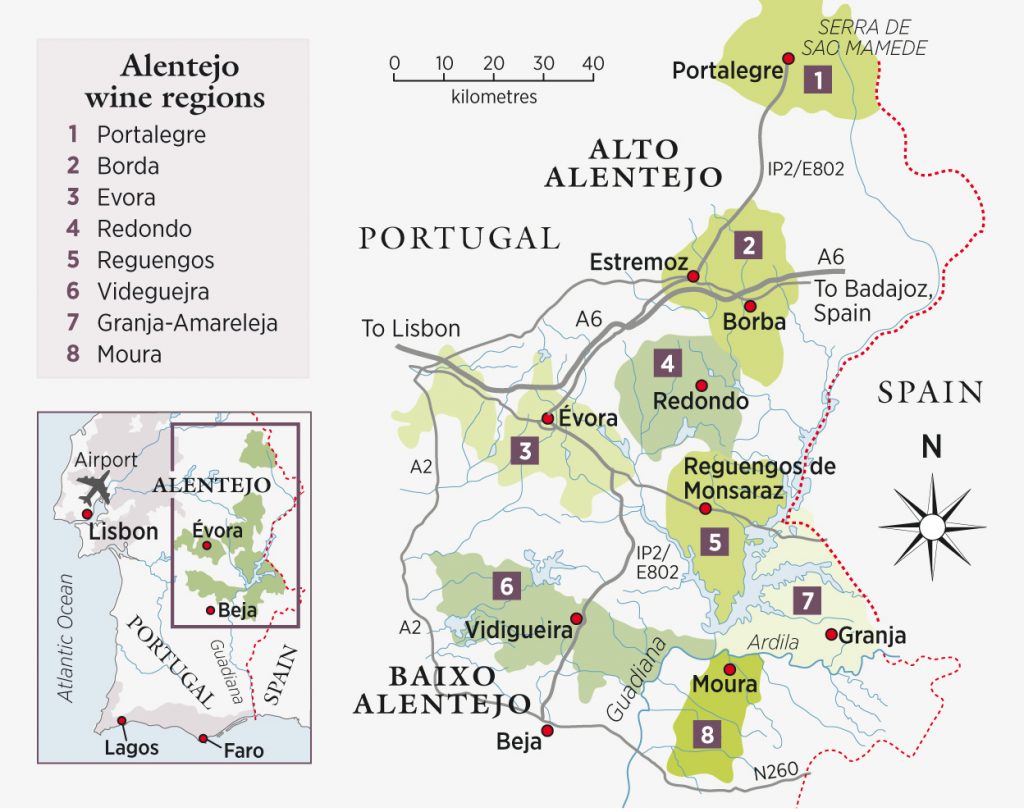
As we move south, the soils shift from granite to schist to limestone; the grape varieties evolve with microclimate and tradition; the winemaking philosophies alternate between ancient clay amphorae and polished modernity. Alentejo is not a single story, but a tapestry of subregions—Portalegre, Borba, Redondo, Évora, Reguengos de Monsaraz, Vidigueira, and Beja—each shaped by its own geology, elevation, and human history.
Northern Gateway: Portalegre – Elevation, Granite, and the Cool Edge of Alentejo
The northernmost expression of Alentejo begins in Portalegre, where vineyards cling to the slopes of the Serra de São Mamede. At elevations rising above 700 meters, this is the coolest part of the region, with cooler nights, more rainfall, and slower ripening cycles that give birth to wines with refined acidity and tension. Granite dominates the geology here, often broken into sandy pockets that offer excellent drainage. Patches of schist emerge toward the lower slopes, bringing a darker mineral signature to the red wines.
The grape varieties here tell the story of altitude and tradition. Arinto thrives in the cool slopes, producing whites with citrus energy and a tight, linear profile. Alicante Bouschet, Trincadeira, and the revived Castelão develop deep colour yet maintain freshness, while old mixed-field plantings contribute complexity rooted in history. Portalegre has long served as a sanctuary for century-old vines, many of which survived successive waves of modernisation due to their remote, rugged terrain.
Producers in this northern enclave have shaped its identity with conviction. Quinta da Fonte Souto, part of the Symington family’s estates, draws on the cool, forested granite soils to produce elegant reds and textured whites. Casa da Urra has deepened Portalegre’s presence with concentrated field-blends that express altitude and schist. Adega de Portalegre, revitalised in recent decades, preserves the old-vine traditions that have come to define the area’s best wines. Estates such as Quinta do Xito, Tapada do Chaves, Herdade da Carochinha, Encosta da Vila, Cabeca de Gaio, and Quinta da Cabaça complete the northern landscape, each contributing variations on Portalegre’s mix of mountain freshness, granite minerality, and old-vine depth.
Southward into Borba – Limestone, Tradition, and the Architecture of Balance
Descending the slopes of São Mamede, the air warms, the vegetation shifts, and the soils begin to change. We enter Borba, a subregion shaped by limestone and clay-limestone blends that have historically supported some of Alentejo’s most structured wines. Borba lies in a transitional band where maritime influence fades and the Mediterranean continental climate becomes dominant, giving warm days, cool nights in summer, and a decisive diurnal shift that helps retain balance.
Borba’s white wines often show a rounder profile than those of Portalegre, but still maintain a mineral line courtesy of the limestone. Antão Vaz, Roupeiro, and Arinto express themselves here with generous fruit yet firm structure. The red varieties—Alicante Bouschet, Aragonez, and Trincadeira—deliver wines of density, moderate alcohol, and a subtle chalk signature that lingers on the palate.
Borba is also the birthplace of some of Alentejo’s most enduring cooperative models, and its winemaking styles remain varied: traditional foot-treading survives proudly next to state-of-the-art cellars. The region’s cultural roots lie deep in agriculture, especially olive oil and marble quarrying, both of which have shaped the identity and labour patterns of the villages.
Producers such as Adega de Borba, one of Portugal’s most historically significant cooperatives, anchor the region’s identity. João Portugal Ramos, whose innovation in the 1990s helped propel the region internationally, continues to craft wines of precision. Estates like Herdade do Mouchão—renowned for its uncompromising, traditional approach to Alicante Bouschet—have shaped Borba’s deeper, more classical soul. Additional estates including Herdade de Rio de Moinhos, Monte do Almo, Quinta da Fonte Nova, Herdade do Sobroso (Borba holdings), Encostas de Estremoz, and Monte Branco contribute to the diversity and reputation of Borba’s limestone-driven wines.
Into the Heartland: Redondo – Warm Valleys, Schist Depth, and Contemporary Alentejo
Moving southeast, the hillsides open into a bowl-shaped valley, and the soils transition again. In Redondo, schist becomes the dominant geological force, offering fractured rock that absorbs heat during the day and releases it slowly overnight, encouraging ripeness and density. Clay pockets mixed with the schist give the wines amplitude and weight. The warmer climate, lower elevation, and generous sunshine make this one of Alentejo’s most reliable areas for full-bodied reds.
Grape varieties here follow the rhythms of the land: Alicante Bouschet achieves its signature inky concentration; Aragonez lends warmth and spice; Syrah—a modern arrival—adds polish and power. The whites, driven by Arinto and Verdelho, deliver tropical fruit edged by schist-driven salinity.
Redondo has become one of the region’s most dynamic centres for modern winemaking. Estates such as Herdade do Freixo, with its extraordinary subterranean gravity-flow winery, represent a new architectural and technological ambition within Alentejo. Esporão’s Redondo vineyards contribute depth to their broader portfolio. Producers including Herdade da Maroteira, Quinta do Paral, Adega de Redondo, Herdade dos Coelheiros, Terras de Alter, Herdade das Servas, and Monte da Ravasqueira reinforce Redondo’s dual identity: rooted in schist and sun, but progressive in technique and vision.
Évora – The Cultural Centre, Limestone Plains, and Philosophical Winemaking
As the journey continues south, the land widens into the open limestone plains surrounding the ancient university city of Évora. This is the symbolic heart of Alentejo, where Roman history, medieval walls, and monastic traditions mingle with contemporary viticulture. Limestone once again becomes central, but it is blended with red clay and pockets of granite, offering versatility and elegance to both whites and reds.
Here the wines reflect the intellectual spirit of the city: balanced, structured, and thoughtful. Antão Vaz, the signature white grape of Alentejo, takes on a more sculpted shape here, with citrus and herbal notes complementing its natural richness. Red varieties express harmony rather than power, with Trincadeira showing remarkable delicacy and aromatics when farmed carefully in cooler pockets.
Évora is home to some of the region’s most respected producers. Cartuxa, with its deep monastic heritage and the celebrated Pêra-Manca wines, stands at the centre of this heritage. Julia Kemper Wines, Fita Preta, and Quinta do Carmo each contribute unique philosophical approaches, from organic viticulture to terroir-focused micro-vinifications. Estates like Herdade do Esporão, Monte da Capela, Herdade da Calada, Encosta da Quinta, and Herdade de Agua complete Évora’s vinous mosaic, balancing tradition with innovation in equal measure.
Reguengos de Monsaraz – Schist Plains, Sun Power, and the Modern Iconography of Alentejo
Travelling southeast toward the Spanish border, the landscape shifts again. In Reguengos de Monsaraz, schist returns with force, forming some of the deepest, darkest, and most heat-retaining soils in the region. Vineyards here experience intense summer heat, moderated only by elevation changes and the vast Alqueva Lake, whose cooling breezes soften the extremes.
Wines from this area tend to be full-bodied, muscular, and expressive, with intense black fruit and a salty, mineral backbone typical of schist. Alicante Bouschet reaches its most emblematic expression here, producing wines with density, structure, and extraordinary ageing potential. The whites, often blends of Arinto, Antão Vaz, and Roupeiro, show surprising freshness despite the heat, thanks to careful night harvesting and precise temperature control.
Reguengos is also the birthplace of some of Alentejo’s most innovative sustainability initiatives. Producers are increasingly adopting regenerative agriculture, drip irrigation management, solar-powered wineries, and low-intervention techniques. The amphora tradition—clay vessels known as talha—remains alive here, linking contemporary wines to Roman antiquity.
Iconic estates such as Herdade do Esporão, CARMIM, Herdade dos Coelheiros, and Herdade da Malhadinha Nova (Reguengos vineyards) define the region’s global profile. Alongside them, critically acclaimed producers like Adega José de Sousa, Herdade de São Miguel, Monsaraz Wines, Herdade da Candeeira, Quinta da Folha, and Terras d’Além continue to carve out the bold, structured identity that Reguengos has become famous for.
Vidigueira – Amphora Traditions, White Wine Heritage, and the Schist-to-Limestone Transition
Further south, the climate becomes warmer still, but Vidigueira offers something unexpected: freshness. This subregion is shaped by a geological fault line that allows cool Atlantic breezes to sweep inland, making it one of Alentejo’s best areas for white wine. Here, limestone meets schist, with sandy pockets that create ideal conditions for aromatic whites.
Antão Vaz—originally from Vidigueira—reaches its most expressive form here, gaining tropical fruit, herbal nuance, and a distinctive mineral line. Reds tend to show more finesse than in the northern schist-dominated zones, thanks to the moderating winds and cooler nights.
Vidigueira is also the epicentre of Portugal’s most ancient winemaking tradition: talha wines. These clay amphorae, introduced by the Romans over two millennia ago, remain a living practice. Many producers dedicate part of their cellar to talha fermentations, harvested and crafted by hand in the old way, without pumps or modern additions.
Influential estates include Herdade do Sobroso, Adega Cooperativa de Vidigueira, Quinta do Quetzal, Herdade Grande, Ribafreixo Wines, Cortes de Cima, Herdade da Figueirinha, Encosta dos Mestres, Casa Agrícola HMR, and Monte da Ribeira. Together, they bridge the past and present, linking Vidigueira’s historical significance with its growing reputation for elegant whites and amphora revivalism.
Beja and the Southern Frontier – Heat, Horizons, and the Modern Face of Alentejo
As the landscape stretches toward the Algarve, the plains widen once more. The southernmost part of Alentejo, centred around Beja, is shaped by extreme heat, rolling cereal fields, and a strong Mediterranean influence. Here, schist, clay, and sandy loam dominate the soils, creating generous, ripe wines with an unmistakable southern character.
The grape varieties reflect the heat: Alicante Bouschet, Aragonez, Touriga Nacional, and Syrah deliver opulence and velvety tannins. Whites lean toward fuller, more powerful styles, often supported by barrel ageing and bâttonage to build structure.
Yet this region also represents modernity and innovation. The estates here tend to be large, technologically advanced, and focused on sustainability—solar energy, water management, and regenerative practices are increasingly integrated into viticulture.
Leading producers include Herdade da Malhadinha Nova, famous for its luxury-driven yet terroir-focused wines; Herdade do Vau, which expresses the Guadiana River’s influence; Casa Relvas, one of the region’s most dynamic and sustainability-driven operations; Herdade dos Grous, known for polished reds and white blends; Herdade da Mingorra, Herdade do Pimental, Monte da Caparica, Herdade de Vale Côvo, Quinta da Estrela, and Monte do Sobral—each contributing to the modern, expansive identity of southern Alentejo.
