Imagine a landscape where the sky feels impossibly wide, where the late-summer sun gilds the rolling hills of the Côte des Bar in molten amber, and where the soil beneath your feet crunches with the broken shells of ancient oysters that once swam in a Jurassic sea. This is the Aube, the wild southern frontier of Champagne, and at its beating heart lies Roses de Jeanne – a domaine so small it could almost hide among the vines, yet so luminous that it casts a long, defiant shadow across the region’s traditions.
History of the Winery
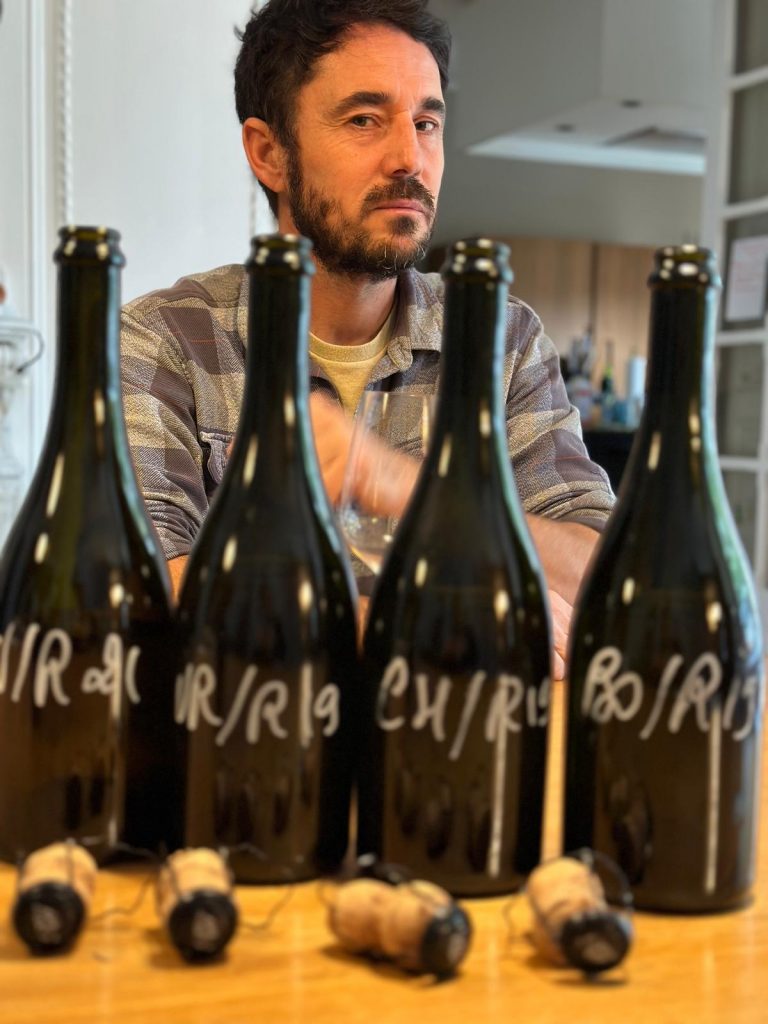
In the year 2000, a young Parisian sommelier named Cédric Bouchard turned his back on the glittering lists of grand restaurants and walked south, back to the village of Celles-sur-Ource where his father still tended vines the old way. He carried with him a single inheritance: 1.37 ha of old Pinot Noir in the lieu-dit Les Ursules, a steep, south-facing amphitheatre of Kimmeridgian marl that looked more like a moonscape than prime vineyard land. From this modest patch he forged Roses de Jeanne, naming it after his Polish grandmother whose fierce tenderness had shaped his childhood. The first wine, a Blanc de Noirs released in 2002, arrived like a quiet thunderclap – unfiltered, barely dosed, and singing with a clarity that made the blended giants of the north seem suddenly opaque.
The early years were monastic. Bouchard worked alone, pressing grapes by hand, fermenting in tiny lots, and sleeping among the barrels when the harvest demanded it. In 2008, the Gault Millau guide crowned him the finest winemaker in all of Champagne, an accolade that felt both miraculous and inevitable. By 2012 he had built his own cellar – a low, whitewashed sanctuary carved into the hillside – finally severing the last logistical ties with his father’s more conventional domaine. From that moment, every drop that bore the Roses de Jeanne label was touched only by Cédric’s own hands and vision. Today, the estate spans just under four hectares, yet its influence ripples far beyond its borders, a beacon for a generation that believes Champagne can – and must – speak with the same crystalline precision as the greatest still wines of Burgundy.
Vineyards & Terroir
Stand in Les Ursules at dawn and you will feel the earth exhale. The soil here is a shattered mosaic of oyster shells and chalky clay, glinting silver in the half-light, so rich in fossilised life that it seems to pulse with memory. Old vines, some approaching seventy years, twist from the ground like gnarled fingers reaching for the sun, their roots burrowing metres deep into the Kimmeridgian seam that links this place geologically to Chablis and Sancerre. On the coldest mornings, mist rises from the Ource river below and clings to the slope like a bridal veil, cooling the grapes and stretching the growing season until the fruit hums with nervous energy.
A kilometre away, Val Vilaine unfurls across gentler contours, its topsoil thinner, its exposure more open to the afternoon breeze that sweeps down from the plateau of Langres. Here the same marl lies closer to the surface, burnished by millennia of wind into a pale, almost luminous crust that crunches satisfyingly underfoot. Further still, the precipitous Côte de Béchalin plunges toward the valley floor, its gradient so severe that every bunch must be harvested by hand, the vines clinging to the slope like mountaineers. And then there is Presle, a secret garden of Chardonnay tucked behind a copse of wild cherry trees, where the soil lightens to pure chalk and the air carries the scent of white flowers even in winter.
Every decision Bouchard makes is designed to amplify these voices: yields are slashed to the bone, sometimes below 20 hl/ha; cover crops of wild grasses and clover carpet the rows; and not a single chemical touches the vines. The result is fruit so concentrated it feels almost electric, carrying within it the salt of prehistoric oceans and the resinous whisper of the forest that borders each parcel.
Wine Portfolio
Open a bottle of Roses de Jeanne and the cork sighs rather than pops – Cédric deliberately bottles at lower pressure, crafting a mousse as delicate as sea-foam. The wines are never chaptalised, never filtered, rarely dosed beyond a breath of liqueur, and often carry no added sulfur. Each cuvée is a solitary hymn: one vineyard, one variety, one vintage, nothing more.
Les Ursules, the beating heart of the domaine, emerges from those ancient Pinot Noir vines like liquid stone made flesh – redcurrant and wild strawberry braided with river-stone minerality, a finish that lingers like the echo of a cathedral bell. Val Vilaine is its brighter sibling, dancing with raspberry and pink grapefruit, its tension coiled like a spring beneath a silken texture. Côte de Béchalin is darker, more brooding – black cherry skin, smoke, and wet earth, wrapped around a spine of tannin that few Champagnes dare to reveal. The Chardonnay of La Haute-Lemblé is pure morning light: lemon blossom, white peach, and oyster-shell salinity that tightens the cheeks and lifts the spirit. And then there is La Bolorée, the rarest of all – a Pinot Blanc so exotic it feels almost illicit, perfumed with lychee, quince, and mountain herbs, produced in quantities that barely fill a few hundred bottles.
These are not wines that shout; they are wines that lean in and whisper secrets only the patient can hear.
Notable Wineries Nearby
The lanes around Celles-sur-Ource wind between hedgerows heavy with blackthorn and elderflower, linking a constellation of growers who share the same stubborn belief in the Aube’s destiny. Just across the village square, Champagne Pierre Brocard occupies a handsome 19th-century house whose courtyard is fragrant with the scent of freshly baked brioche from the cellar’s own levain. Here, generations have coaxed elegance from Pinot Noir, and their Brut Tradition – aged three patient years on lees – marries golden apple and toasted hazelnut with a finesse that belies its humble price.
A few kilometres along a road flanked by poppy fields lies Champagne Eric Legrand, where the vines are tended with the quiet devotion usually reserved for sacred relics. Legrand’s Millésime is a pure Pinot Noir that captures the Aube’s wild soul: sour cherry, blood orange, and a saline snap that makes the mouth water long after the glass is empty.
Turn south and you reach Champagne Huguenot-Tassin, whose Rosé de Saignée is bled from old vines at moonrise, yielding a wine the colour of coral at sunset – wild strawberry, rosehip, and a whisper of black pepper that makes it the perfect companion to grilled langoustine.
In the next valley, the Cheurlin family at Champagne Richard Cheurlin farm organically beneath skies so clear the Milky Way feels close enough to touch. Their Blanc de Blancs is a study in precision: lime zest, white lilac, and a chalky grip that lingers like a promise.
Finally, follow the Ource upstream to Bar-sur-Seine and the majestic manor of Champagne Devaux, a cooperative reborn as a temple of ambition. The Cuvée D – aged partly in large oak foudres – marries richness and tension in a way that feels both timeless and thrillingly modern, its notes of roasted almond and mirabelle plum unfolding like a slow, luxurious sigh.
Together, these estates form a quiet revolution, proving that in the far south of Champagne, the future is being written one perfectly transparent bubble at a time. And at the centre of it all, Roses de Jeanne continues to shimmer – a tiny domaine with an enormous soul, reminding us that the greatest wines are not made, but revealed.
