Few names in Italian wine evoke as much reverence, curiosity, and debate as Soldera. In the hills of southern Tuscany, just outside the medieval town of Montalcino, this estate has become a synonym for purity — not only in winemaking but in philosophy, culture, and identity. To understand Soldera is to enter the mind of one of wine’s great individualists, Gianfranco Soldera, whose unwavering belief in natural balance and uncompromising authenticity created a legacy that continues to shape how the world perceives fine Italian wine.
History of the Winery
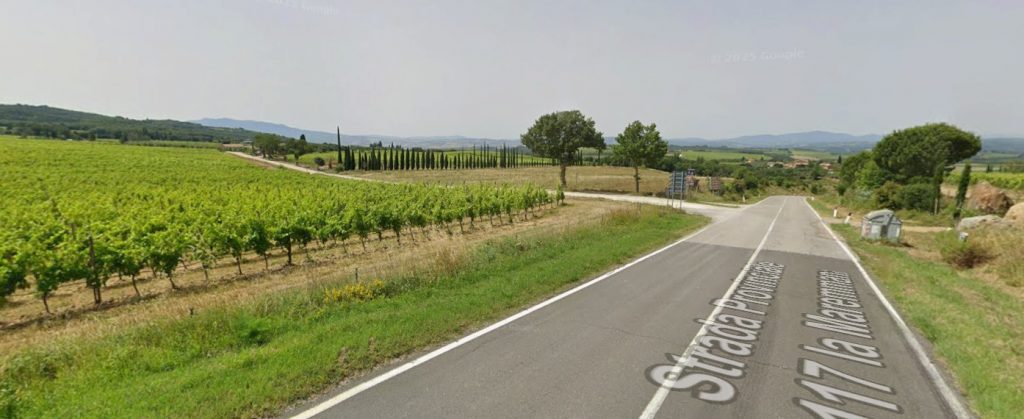
The story of Soldera begins in 1972, when Gianfranco Soldera, a Milanese insurance executive with a passionate obsession for wine, purchased a property called Case Basse on the southwestern slopes of Montalcino. At the time, this was a remote corner of Tuscany, largely untouched by the fame that Brunello di Montalcino would later achieve. The land, roughly 23 hectares surrounded by oak forests and wild flora, captured Soldera’s imagination for its potential to produce wines of absolute integrity. From the beginning, he envisioned Case Basse not as a business venture but as a lifetime pursuit — a living organism that would reflect the natural harmony between vine, soil, and ecosystem.
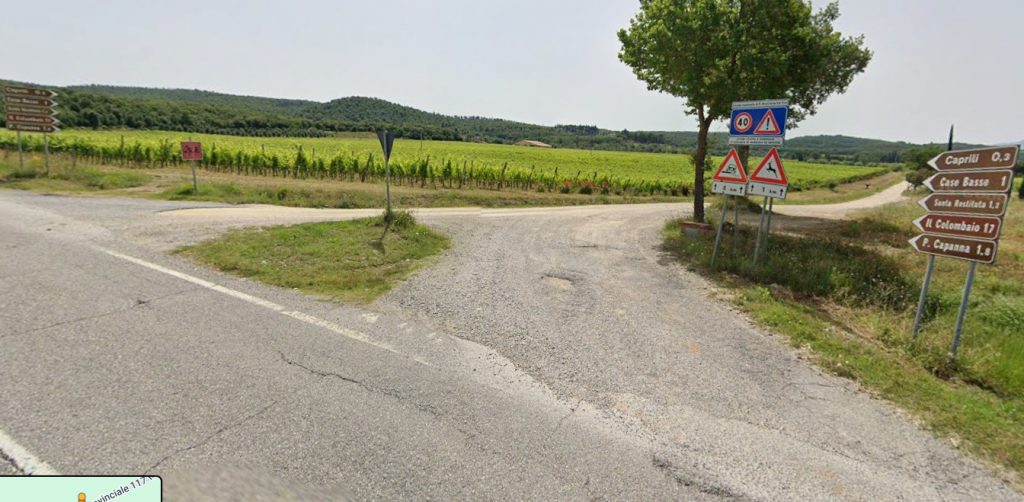
Soldera’s first vintage was produced in 1975, and from that moment, he set out to redefine what Brunello could be. His approach was radical for the time: minimal intervention in both vineyard and cellar, long macerations on the skins, and aging exclusively in large Slavonian oak casks. In an era when many producers were chasing international styles, Soldera stood apart. He insisted on indigenous yeast fermentations, no temperature control, no filtration, and an almost ascetic attention to vineyard health. Over the decades, the wines of Case Basse — labeled as “Soldera Brunello di Montalcino” — gained cult status for their extraordinary purity, longevity, and aromatic complexity.
A tragic turning point came in 2012 when a disgruntled former employee broke into the cellar and destroyed more than 60,000 liters of wine by opening the casks. The loss was catastrophic, wiping out years of work. Yet from that devastation, Soldera’s philosophy only deepened. He chose not to rebuild within the confines of the Brunello di Montalcino DOCG, withdrawing from the appellation system altogether. From 2013 onwards, his wines would simply be labeled “Soldera Case Basse Toscana IGT,” free from bureaucratic constraints — a symbolic act of independence that reaffirmed his devotion to purity above all else.
The People
At the heart of Soldera’s vision was Gianfranco himself, a man described by friends and critics alike as uncompromising, articulate, and fiercely devoted to his ideals. He viewed wine not as a product but as a natural expression of life — the culmination of patience, observation, and respect for the environment. His death in 2019 marked the end of an era, yet the estate remains very much alive under the leadership of his wife Graziella and their children Monica and Mauro.
Today, the Soldera family continues to safeguard the principles that defined the estate from its inception. The team is deliberately small, emphasizing precision and consistency in every aspect of viticulture. There is a near-spiritual reverence for the land — each vine is tended individually, and every detail, from pruning to harvest timing, is guided by experience rather than formula. The cellar, designed with the help of noted botanists and agronomists, remains a sanctuary of simplicity: natural fermentation, open-top oak vats, and a serene atmosphere where time seems to slow.
Vineyards & Terroir
Case Basse lies in one of the most distinctive microclimates of Montalcino, around 320 meters above sea level, facing southwest. Unlike the denser clay soils found in the northern part of the region, the vineyards here rest on a mosaic of galestro, limestone, and marl — a composition that allows for excellent drainage and deep root penetration. This geology, combined with the moderating influence of Mediterranean breezes and significant diurnal temperature variation, creates an environment perfectly suited for Sangiovese Grosso, the noble grape of Montalcino.
The estate’s two main vineyard parcels, Case Basse and Intistieti, cover around eight hectares in total. What sets them apart is not only their exposure and soil composition but their extraordinary biodiversity. Gianfranco Soldera believed that the health of the vineyard depended on the balance of its ecosystem, and to that end, he established one of the most extensive botanical gardens in Tuscany on the property. More than 1,500 species of plants, trees, and flowers coexist alongside the vines, fostering an environment where beneficial insects and microorganisms thrive. No herbicides, pesticides, or synthetic fertilizers are used — the vineyard functions as a self-sustaining organism.
This attention to natural equilibrium gives the wines their unmistakable character: aromatic precision, textural depth, and an almost ethereal clarity that transcends varietal definition. In Soldera’s view, terroir was not merely a matter of soil and climate but a living expression of the vineyard’s total environment, cultivated through observation and respect rather than manipulation.
Wine Portfolio
Soldera’s wines are crafted exclusively from 100% Sangiovese Grosso, and each vintage is a reflection of that year’s natural rhythm. The core wine, now labeled “Soldera Case Basse Toscana IGT,” remains among Italy’s most sought-after. It spends several years in large Slavonian oak botti before being bottled unfiltered, with only the gentlest handling throughout the process. No barriques, no temperature control, and no additives are ever employed. The result is a wine that evolves for decades, revealing layers of red fruit, dried rose, truffle, tobacco, and forest earth with time.
Each vintage differs profoundly — not because of human intervention, but because Soldera believed that wine should mirror nature’s variation. His philosophy rejected the pursuit of stylistic consistency in favor of authenticity. Even within the same parcel, subtle differences in vine age and exposure create nuances that he chose to preserve rather than blend away.
The wines’ longevity is legendary. Older vintages, particularly those from the 1980s and early 1990s, demonstrate remarkable vitality, their aromas unfolding in a slow, meditative progression. Modern vintages, overseen by the next generation, continue in the same spirit: a dialogue between land and time, guided by patience and conviction rather than technology.
Five Notable Wineries Nearby
The hills surrounding Montalcino are home to some of Italy’s most prestigious and distinctive estates, each contributing its own interpretation of Sangiovese Grosso. A short drive from Case Basse lies Biondi-Santi, the historic estate where Brunello di Montalcino was born in the 19th century. Ferruccio Biondi-Santi’s pioneering work defined the standard for long-lived Sangiovese, and the wines of Tenuta Greppo remain benchmarks of classical elegance — restrained, aromatic, and built for decades of aging.
Just to the north, Poggio di Sotto stands as another pillar of traditional winemaking. Founded in 1989 by Piero Palmucci and now owned by Collemassari, it is celebrated for its purity and grace. Its vineyards on galestro-rich slopes produce Brunellos that are both powerful and refined, marked by red cherry, dried herbs, and a silky texture that recalls Burgundy in its finesse.
Further east, Salvioni – La Cerbaiola maintains one of the smallest yet most revered productions in Montalcino. Giulio Salvioni’s philosophy mirrors Soldera’s dedication to authenticity — limited yields, spontaneous fermentations, and patient maturation in large oak casks. His Brunellos are richly perfumed, combining fruit depth with haunting mineral precision.
To the south, Le Ragnaie, owned by Riccardo Campinoti, explores the high-altitude expression of Sangiovese with vineyards reaching over 600 meters above sea level. The wines, though modern in clarity, remain profoundly rooted in the tradition of elegance and transparency. They showcase how altitude can sculpt Sangiovese into a taut, floral, and vividly pure expression of Montalcino’s upper slopes.
Finally, Il Marroneto, under the direction of Alessandro Mori, continues to uphold the old-world spirit of the region. Situated on the northern slopes near Montalcino town, its wines are distinguished by their vertical structure, purity of fruit, and haunting aromatics. The estate’s “Madonna delle Grazie” is considered one of the most beautiful single-vineyard Brunellos produced today — a testament to artisanal winemaking and uncompromising terroir expression.
Tasting notes
2015 Soldera
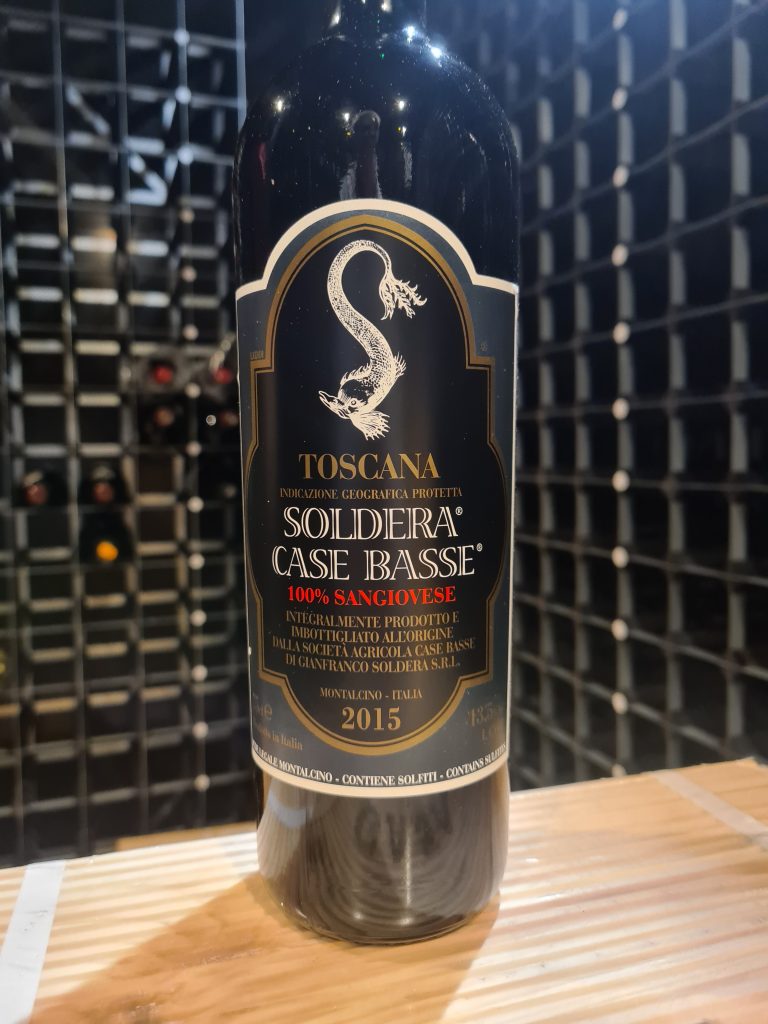
The 2015 Soldera Case Basse is a wine of quiet authority and luminous depth. In the glass, it shows a translucent ruby hue, alive with movement. The nose is immediately captivating — red cherry, dried rose, and blood orange layered with hints of tea leaf and subtle spice. Every aroma feels poised and exact, unfolding with unhurried grace.
The palate is pure and vertical, driven by finely etched acidity and silky tannins. Bright fruit glides over a cool mineral line, carrying flavours of sour cherry, citrus peel, and dried herbs. It moves with remarkable precision — weightless yet deeply resonant. The finish lingers effortlessly, vibrating with energy and calm in equal measure. A wine that feels both alive and perfectly still.
