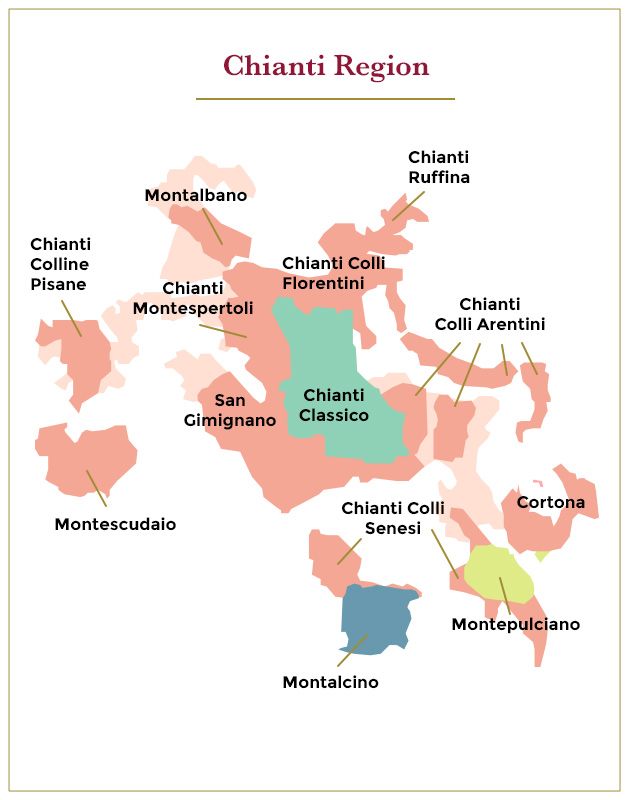
Tucked quietly into the northeastern hills above Florence, where the Tuscan landscape rises toward the first soft slopes of the Apennines, lies a region that has long whispered rather than shouted its greatness — Chianti Rufina. Smaller, higher, and cooler than its famous sibling, Chianti Classico, Rufina stretches across a series of wooded valleys and ridges that follow the course of the Sieve River. Here, the landscape itself seems to breathe a slower rhythm. The vineyards are etched into the mountainsides, often between 200 and 600 meters above sea level, where Sangiovese ripens gently under the tempered sunlight of Tuscany’s northern frontier.
This journey through Rufina unfolds from its northernmost reaches near Dicomano, where the Apennines cast their cooling influence, down through the historic heart of Pontassieve and Pelago, and finally toward the southern boundary near the rolling hills that overlook the Arno Valley. Along the way, the soils, grape varieties, and philosophies shift subtly, revealing a mosaic of terroirs that shape one of Italy’s most refined expressions of Sangiovese.
The Northern Gateway – Dicomano and Londa
In the northern stretches, near Dicomano and Londa, Chianti Rufina reveals its most rugged face. The vineyards rise sharply from forested slopes, with altitudes surpassing 500 meters, and the soils here tell a story of geological tension — ancient schist and fractured sandstone known locally as galestro, mixed with veins of marl and the occasional granite intrusion from the Apennine foothills. These stony, well-drained soils force the vines to dig deep, producing Sangiovese grapes of intense fragrance and firm acidity. The wines of this northern belt often show a cool, alpine precision — red cherry, wild herbs, and fine-grained tannins, more restrained in fruit yet vibrant in structure.
The local microclimate is marked by sharp diurnal shifts: warm, bright days followed by cool nights that can drop dramatically, preserving aromatic freshness. The influence of the Sieve River moderates extremes, while breezes from the mountains keep the vineyards ventilated and disease pressure low — ideal for sustainable and organic viticulture, which many producers here have embraced.
Notable Producers
Among the estates shaping this northern zone are Frascole, a biodynamic pioneer whose wines combine structure with floral finesse; Fattoria di Petrognano, known for its crystalline Sangiovese and Cabernet Franc blends; and Il Pozzo, which produces wines of mineral purity rooted in schist-rich soils. Fattoria di Selvapiana, while based further south, maintains parcels in these cooler areas, showcasing their high-altitude character in select bottlings. Fattoria Lavacchio, perched near Pontassieve but with vineyards extending northward, has long championed organic methods, with vineyards that serve as a bridge between the mountain edge and the heart of Rufina. Podere Il Balzo, Fattoria Caiano, Marchesi Gondi – Tenuta Bossi, Villa Travignoli, and Tenuta di Grignano round out the key producers contributing to this northern narrative — each with deep family roots and an enduring respect for the land.
The Heart of Rufina – Pelago and Rufina
As one descends southward toward the communes of Rufina and Pelago, the scenery opens. Vineyards stretch across terraced hillsides, interspersed with olive groves and cypress-lined roads leading to centuries-old estates. Here, elevation averages between 300 and 450 meters. The soils become more complex — marl and clay alternate with compact limestone, and patches of loamy alluvium near the river provide richer textures for blending varieties. These soils retain moisture during the dry summer months and lend a rounder, more supple texture to the wines.
This is where Sangiovese expresses both its strength and grace. The wines gain depth and ripeness without losing freshness — notes of cherry, tobacco leaf, violets, and dried herbs give way to a long, mineral-driven finish. Small quantities of Colorino and Canaiolo are still used traditionally for blending, adding color and softness, while some producers incorporate Cabernet Sauvignon or Merlot for structure and depth.
The climate here remains distinctly cooler than in central Tuscany, though the southern exposure of many vineyards provides ample sunlight. The Sieve River meanders through the valley, its reflective light aiding ripening, while the surrounding forests maintain a cool microclimate that delays harvest — often by two or three weeks compared to Chianti Classico.
Winemaking philosophy here ranges from traditional large botti aging, as practiced by Gondi and Selvapiana, to modern precision using French oak and temperature-controlled fermentations at estates like I Veroni. What unites them is a shared respect for Sangiovese’s natural restraint and the transparency of their terroir. Sustainability has become a common theme, with several estates converting to organic or biodynamic farming — not as marketing gestures, but as reflections of centuries-old symbiosis with the land.
The Southern Slopes – Pontassieve and Beyond
As the journey continues southward toward Pontassieve, the Rufina hills soften into gentler contours that merge with the outskirts of Florence. Here the altitudes descend to around 200–250 meters, and the soils show greater diversity — more clay and sand near the valleys, with alluvial deposits that offer a warmer, fuller style of wine. The climate is milder, and ripening occurs earlier, resulting in fruit-driven wines with softer tannins and approachable textures.
The vineyards in this southern area are often more exposed to sunlight and less influenced by the mountain winds, giving rise to Sangiovese that leans toward ripe cherry, plum, and spice notes. Some estates here have embraced modern winemaking techniques — shorter macerations, smaller oak barrels, and careful blending — producing wines that retain Rùfina’s freshness but with an added generosity of fruit. Others continue the slow, traditional methods, seeing Rufina not as a style to be modernized, but as a timeless identity to be preserved.
Notable Producers
Prominent names in this southern zone include Frescobaldi’s Castello di Nipozzano, whose historical cellars date back to the 11th century and whose Riserva bottlings helped bring Chianti Rùfina to international attention. I Veroni stands out for its organic-certified vineyards and a philosophy rooted in precision and purity, while Fattoria di Lavacchio, perched high above Pontassieve, produces wines that marry structure and softness under a strict organic regime.
This southern portion also reflects Chianti Rufina’s increasing embrace of sustainability. Solar energy use, biodiversity projects, and organic vineyard management have become defining features. The balance between heritage and innovation is delicate, yet remarkably consistent across producers who see Rufina not as an extension of Chianti Classico, but as a world apart — a mountain-born, climate-tempered expression of Tuscany’s soul.
A History Etched in Stone and Tradition
The roots of Chianti Rufina stretch deep into Tuscany’s past. Viticulture here dates to Etruscan times, with Roman settlers later cultivating vines along the fertile valleys of the Sieve. The first documented reference to Rufina’s wines appears in the 18th century, when the Medici family recognized the area’s unique climatic advantages for Sangiovese. In 1716, Grand Duke Cosimo III de’ Medici officially designated Rufina among the original four “Chianti” zones protected by law — centuries before modern appellation systems were established.
Throughout the 19th and 20th centuries, Rufina quietly cultivated a reputation among connoisseurs for longevity and finesse, even as its modest scale limited global recognition. The large estates — many still family-owned — became custodians of both heritage and experimentation. The Gondi, Frescobaldi, and Giuntini families played defining roles in maintaining continuity through wars, economic upheaval, and changing tastes. Today, their descendants work alongside a new generation of winemakers who combine tradition with modern precision, ensuring that Rufina’s distinct voice continues to resonate.
