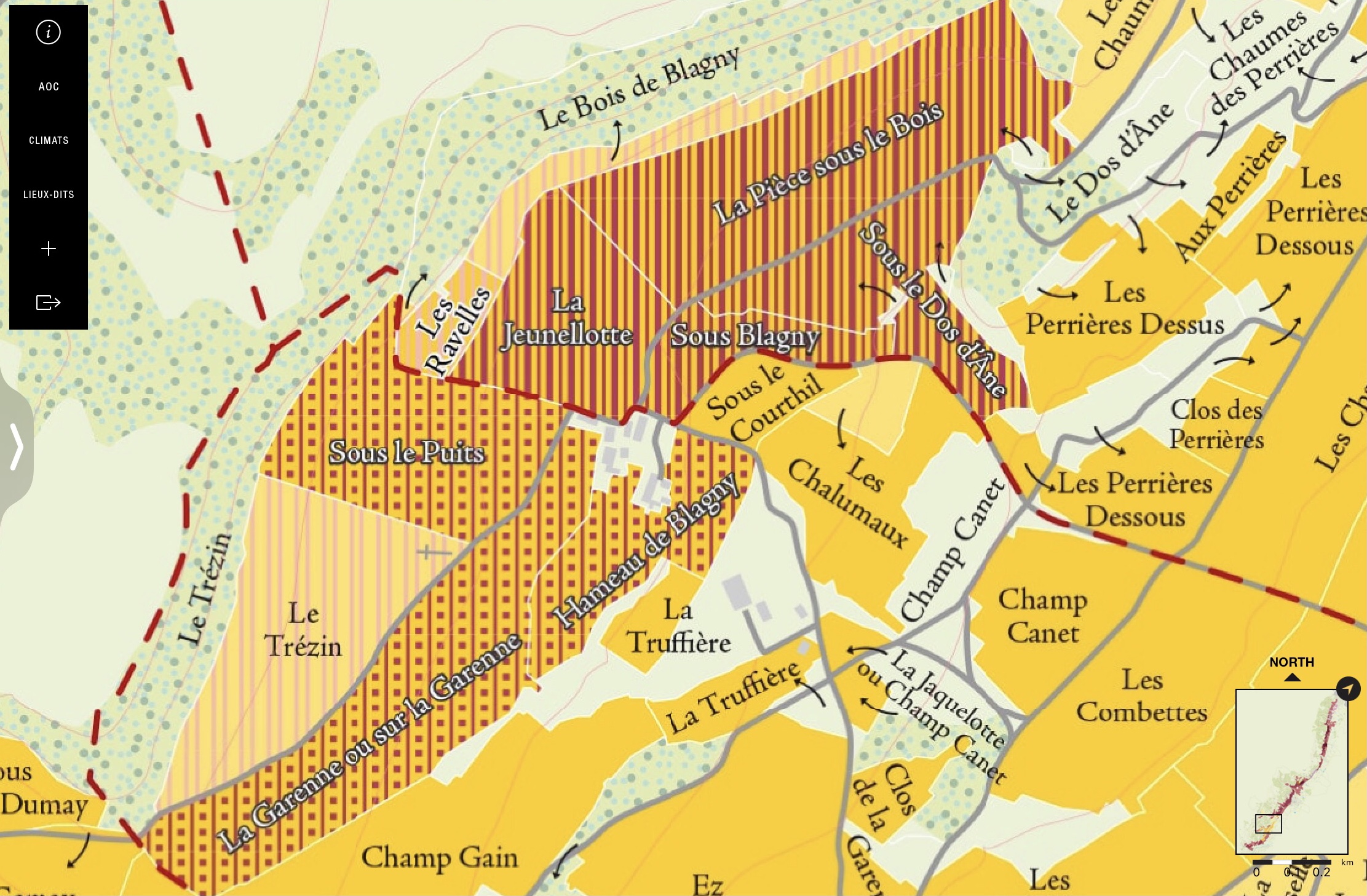
Nestled amidst the hills between Meursault and Puligny, you’ll find the tranquil hamlet of Blagny. Here, peace prevails. Birds serenade, and the vineyards are interspersed with hedgerows, copses, and a vibrant array of wildflowers in the spring. The village itself consists of merely a handful of houses centred around the old manor, once owned by the late Comtesse de Montlivault. Blagny stands leagues away from the hustle and bustle of Beaune. It is a unique appellation solely dedicated to red wines. However, when white wines are produced, they become Meursault-Blagny premier cru or, less commonly, Meursault followed by one of the names of the Blagny premiers crus. Village Meursault land is scarce in this area. Alternatively, if the dividing line of the commune runs through the middle, the white wine can bear the label Puligny-Montrachet. There is a slightly larger presence of communal Puligny vineyards in this region (specifically the lieu-dit of Le Trézin) than communal Meursault vineyards. Technically, the Puligny-Montrachet premiers crus of Sous le Puits, La Garenne, and Hameau de Blagny are considered Blagny premier cru if they produce red wine.
The vineyard land climbs up to 360 meters, with an Argovian marl soil covered in limestone debris. Upslope, the soil exhibits a reddish hue and an abundance of pebbles, while lower down, it is less pebbly. On the Meursault side, the underlying rock is weathered, crumbly, and white, sometimes with a hint of blue. The orientation faces southeast. On the Puligny side, the soil is deeper, the underlying rock firmer, and the colour redder. Here, pebbles are most prevalent.
THE VINEYARD
There are eight premiers crus in Blagny, listed as follows:
- La Jeunelotte (5.05 hectares) – Meursault
- La Pièce Sous le Bois (11.15 hectares) – Meursault
- Sous le Dos d’Ane (5.03 hectares) – Meursault
- Sous Blagny (2.21 hectares) – Meursault
- Sous le Puits (6.80 hectares) – Puligny-Montrachet
- La Garenne or Sur la Garenne (9.87 hectares) – Puligny-Montrachet
- Hameau-de-Blagny (4.28 hectares) – Puligny-Montrachet
- Les Ravelles (1.30 hectares) – Meursault
This totals an area of 45.69 hectares, with 24.74 hectares in Meursault and 20.74 hectares in Puligny-Montrachet. Additionally, there are 9.73 hectares of village land, with 1.77 hectares in Meursault and 7.96 hectares in Puligny-Montrachet. The vineyards produce approximately 220 hectoliters of Blagny premier cru rouge and 45 hectoliters of village Blagny rouge per year, along with around 400 hectoliters of Meursault premier cru Blagny and 60 hectoliters of village Meursault.
Blagny rouge is a rather robust wine, akin to a cross between a Chassagne-Montrachet and a Pommard, representing the best of both. In its youth, it can be reserved and sturdy. However, given time, it mellows into a wine of character and depth. Although it may not be in vogue, it possesses a charm that comes at an affordable price. Undoubtedly, it offers more intrigue than red Meursault. Similar to the hill of Corton, Chardonnay is planted on the upslope, while Pinot Noir thrives lower down, with the best climats for red wine found in La Pièce sous le Bois and Sous le Dos d’Ane.