Livio Sassetti has long been regarded as one of Brunello’s most steadfast classical voices on the cooler, wind-blown northern slopes of Montalcino, where altitude tempers force and patience shapes character. The estate, known by its historic name Pertimali, represents a vision of Sangiovese that is based on proportion, clarity, and time rather than force or fashion. Sassetti’s wines have stayed quietly consistent in an appellation that has seen numerous transformations. Their authority is based on restraint rather than volume and on an uninterrupted conversation between grape, season, and cellar.
The Winery’s Past
The territory of Pertimali itself is inextricably linked to the tale of Livio Sassetti. When Brunello di Montalcino was still a tiny, nearly isolated designation in the 1960s, the Sassetti family purchased the land. There were only a few producers in the area at the time, and Brunello was not yet the world-renowned luxury brand that it would eventually become. With his background in agriculture and winemaking, Livio Sassetti saw the possibilities of Montalcino’s colder northern exposures, especially in the vicinity of Canalicchio, where elevation and wind offered grace rather than bulk.
Livio Sassetti’s first Brunello di Montalcino was launched in the middle of the 1960s, coinciding with the appellation’s early years. The winery has always been independent. Sassetti concentrated on improving vineyard work, comprehending clonal material, and maintaining the integrity of classic Brunello élevage, whereas others experimented vigorously or expanded quickly. Pertimali set a benchmark for what many call to as “classical Brunello” over the years. This style is characterised by hard yet polished tannins, aromatic clarity, and the capacity to change subtly with time.
Livio Sassetti rejected the need to modernise Brunello by using barrique or riper extraction during times of stylistic controversy, especially in the 1990s and early 2000s. Rather, the estate strengthened its standing among purists and experts as a standard of continuity in a more divisive environment by reiterating its fundamental beliefs.
The People
Livio Sassetti, who is more well-known for his prudence than his public persona, is at the centre of Pertimali. His method has always been based on a profound respect for the seasonal and vine cycles as well as observation rather than interference. His son Lorenzo Sassetti is a key player in both winemaking and vineyard management, and the estate is now firmly in the hands of the next generation. Lorenzo is a symbol of continuity rather than discontinuity; he upholds his father’s stylistic compass while introducing technical accuracy and modern viticultural knowledge.
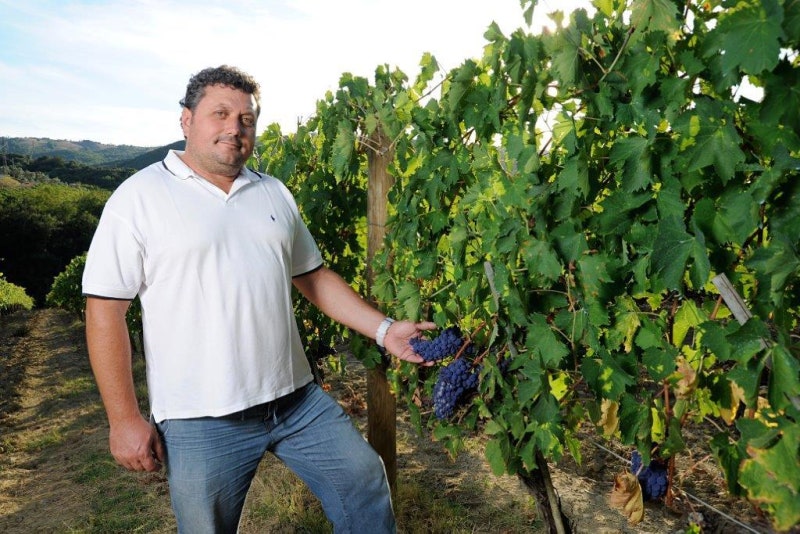
The foundation of the Sassetti philosophy is listening, not guiding. Balance and a dislike of excess serve as the guiding principles for decisions in both the vineyard and the cellar. The group prioritises vine health, gradual climate change adaptation, and consistency among vintages while working from a long-term perspective. Beyond what the vineyards naturally provide, there is no intention to enhance the wines. Because of its human scale and family-run organisation, Pertimali is able to function without compromise and without the pressures that frequently come with business growth.
Terroir & Vineyards
The northern side of Montalcino, which has historically been linked to freshness, aromatic lift, and structural tension, is where Pertimali’s vines are situated. The vineyards benefit from milder daytime temperatures and noticeable diurnal variations because they are situated at elevations that are typically between 280 and 320 m above sea level. The estate’s unique Brunello profile is shaped by this climate profile, which prolongs the growing season, slows ripening, and maintains acidity.
The majority of the soils are clay-rich marl and galestro, with limestone pockets adding to the mineral foundation of the wines. These soils naturally reduce vine vigour and promote deep root systems due to the slope and exposure. Instead of sheer concentration, the resultant grapes typically exhibit bright acidity, modest sugar buildup, and finely grained tannins.
At Pertimali, sustainability and environmental awareness are highly valued aspects of viticulture. Because vineyard work is mostly done by hand and chemical inputs are kept to a minimum, precision canopy control and selection are possible. Instead of using forceful green harvesting, yields are managed by careful study of each parcel’s inherent potential and balanced trimming. The northern terroir of Pertimali has proven to be a strategic asset in an era increasingly characterised by climate unpredictability, enabling the estate to retain freshness and clarity even in warmer vintages.
Portfolio of Wines
Because he believes that depth comes from refinement rather than broad, Livio Sassetti has purposefully narrowed his wine selection. Brunello di Montalcino, which is made only from Sangiovese Grosso, is its central component. Usually, fermentations occur in concrete or stainless steel, with prolonged macerations that emphasise mild extraction. Large Slavonian oak casks, which promote gradual oxygen exchange without imposing overt wood character, are used for ageing.
Instead of overt sweetness or spice, the Brunello is characterised by its linear structure and aromatic richness, giving red cherry, dry herbs, iron, and subtle balsamic notes. These wines reward patience in the cellar as they develop layers of tobacco, forest floor, and savoury depth over time. In addition to Brunello, the estate makes Rosso di Montalcino, which is a genuine representation of the same terroir that has been vinified for earlier accessibility while maintaining structural integrity.
Brunello Riserva, which comes from the estate’s best-balanced parcels and is matured for a long time before being released, is also bottled by Livio Sassetti in some vintages. These wines, which prioritise harmony and longevity above initial impact, are the pinnacle of the Pertimali philosophy. Acidity is maintained, alcohol content is measured, and the wines consistently express location rather than method throughout the collection.
Notable Wineries in the Area
Several estates in Montalcino’s northern sector, like as Livio Sassetti, have influenced Brunello’s classical character. Brunello di Montalcino was historically born in Biondi-Santi, which is close to Pertimali. Its long-lasting, ethereal wines, which emphasise longevity, structure, and aromatic restraint, have shaped the appellation’s early aspirations.
Another neighbouring estate, Tenuta Le Potazzine, has won praise for its sophisticated, terroir-driven Brunellos. It was established more recently and shares a dedication to precision and freshness, creating wines that blend finely etched tannins with flowery aromatics. Gianni Brunelli-Le Chiuse di Sotto, which is located a little closer to the town of Montalcino, creates Brunellos that are balanced and generous, with careful vineyard work at their core, bridging traditional and modern tastes.
A contrasting stylistic range can be found further north in Casanova di Neri, especially in its renowned Cerretalto vineyard, which produces robust, age-worthy Brunellos. Although it takes a more contemporary approach, it highlights the variety of expression that is possible in the northern zones. Last but not least, Altesino, one of Montalcino’s oldest estates, has long supported single-vineyard bottlings and helped popularise the idea of “cru” Brunello, illustrating how site specificity can strengthen Sangiovese’s voice.
A Classical Source in a Changing World
For those who want to comprehend Brunello di Montalcino beyond fads and stylistic arguments, Livio Sassetti continues to be a benchmark. Pertimali’s wines, which are influenced by a family philosophy that prioritises continuity over reinvention and a terroir that favours complexity, speak softly but firmly. Sassetti’s Brunellos serve as a reminder that greatness in wine is frequently determined by coherence over time rather than volume or impact in the context of contemporary wine debate, when immediacy frequently overshadows endurance.
