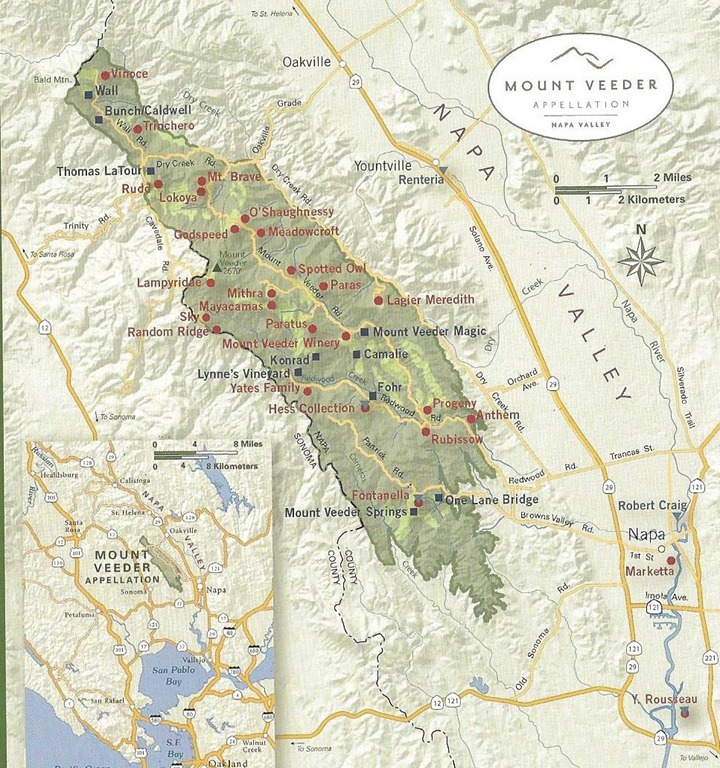
Rising abruptly from the western edge of Napa Valley and stretching southward toward the fog-laced margins of San Pablo Bay, Mount Veeder is one of California’s most exacting and intellectually rewarding winegrowing landscapes. To travel from its northernmost ridgelines to its southern, maritime-influenced slopes is to move through shifting geology, elevation, and climate, but also through the layered history of Napa Valley itself. This is mountain viticulture in its purest form: steep, forested terrain wrested into vineyard form, naturally low yields dictated by soil and exposure, and wines shaped more by structure, acidity, and longevity than by immediate seduction.


From the Mayacamas Spine to the Central Slopes: Geology, Elevation, and Mountain Cabernet
The northern reaches of Mount Veeder begin near the Mayacamas spine above Oakville and Yountville, where vineyards climb to elevations of 600 to over 700 metres.
The northern reaches of Mount Veeder begin near the Mayacamas spine above Oakville and Yountville, where vineyards climb to elevations of 600 to over 700 meters. Here, the topography is dramatic and unforgiving, with narrow ridges, sheer inclines, and deeply incised ravines that funnel cold air at night and wind during the day. Geologically, this zone sits firmly within the Franciscan Complex, a chaotic assemblage of uplifted marine sediments formed over 150 million years ago. Soils are shallow and skeletal, composed of fractured sandstone, shale, graywacke, and pockets of decomposed schist, often with calcareous marine remnants that lend a subtle limestone-like tension to the wines. Organic matter is scarce, drainage is extreme, and vine vigour is naturally restricted, resulting in small berries with thick skins and high phenolic density.
Cabernet Sauvignon dominates these upper northern vineyards, but it expresses itself here with a severity and restraint that set it apart from valley-floor examples. Aromas of cassis, graphite, crushed stone, and dried mountain herbs are common, while the palate is driven by firm tannins and vibrant acidity rather than sweetness or sheer weight. Cabernet Franc plays an important supporting role, particularly on cooler, wind-exposed parcels where its aromatic lift and linear structure thrive. Small plantings of Merlot persist, largely for blending, contributing texture rather than opulence. The extended growing season, often stretching into late October, allows for full phenolic ripeness at moderate sugar levels.
Mayacamas Vineyards stands as the philosophical cornerstone of this northern zone. Founded in 1889 and revived in the post-Prohibition era, it has shaped Mount Veeder’s identity more than any other estate. Its high-elevation vineyards, planted between 550 and 650 meters, are farmed with an emphasis on balance rather than yield, and the wines are made using native fermentations and long élevage in large-format oak. The resulting Cabernets are austere in youth yet legendary for their ability to evolve over decades. Nearby, Veeder Peak and Mt. Brave draw from similarly elevated, rocky sites, crafting mountain Cabernets that emphasize mineral tension, savory complexity, and ageworthiness. These producers helped establish Mount Veeder as Napa Valley’s intellectual counterweight to the plush, valley-floor style that rose to prominence in the late twentieth century.
Moving southward along the mountain, elevations gradually moderate to between 350 and 550 meters, and vineyard aspects become more varied, with parcels facing east toward Napa Valley and west toward Sonoma County. This central corridor represents Mount Veeder’s geological and stylistic crossroads. Volcanic influences become more pronounced, with red and brown basalt-derived soils interwoven with clay loam and weathered marine sediments. These soils retain slightly more moisture while remaining low in fertility, allowing for a broader palette of grape varieties without sacrificing concentration or structure.
Cabernet Sauvignon remains the anchor variety, but the central zone reveals Mount Veeder’s versatility. Syrah finds a natural home in cooler pockets and on west-facing slopes, producing wines of pepper, smoked meat, violets, and dark olive that owe more to the Northern Rhône than to typical Californian expressions. Malbec and Petite Sirah appear in historic plantings, valued for color, mid-palate density, and tannic backbone, while old-vine Zinfandel survives in isolated parcels, offering a more savoury, restrained interpretation of the variety. Winemaking philosophies here tend toward minimal intervention, with gentle extraction, moderate oak usage, and an emphasis on vineyard expression over cellar polish.
Hess Persson Estates is the most influential modern force in this central stretch of Mount Veeder. Established in the late 1970s, Hess was among the first to demonstrate that serious, large-scale investment in mountain viticulture was not only viable but capable of producing wines of international stature. Their extensive vineyard holdings span a wide range of elevations and soil types, enabling detailed exploration of Mount Veeder’s internal diversity. Lagier Meredith, by contrast, represents the mountain’s artisanal soul. Farming steep, low-yielding vineyards with meticulous attention, the estate has become iconic for its site-transparent Syrah and finely etched Cabernet Sauvignon, wines that have earned near-mythical status among sommeliers.
Toward the Bay: Maritime Influence, Varietal Diversity, and the Southern Expression
As the journey continues south, Mount Veeder begins its descent toward Carneros and the northern edge of San Pablo Bay. Maritime influence becomes increasingly dominant, with cool afternoon winds and persistent morning fog shaping the growing season. Elevations here drop to 150–300 meters, and soils deepen slightly, with a higher proportion of clay mixed with volcanic ash and sedimentary debris. These conditions slow ripening and favor grape varieties that excel in cooler climates and longer hang times.
Chardonnay and Pinot Noir appear in small but compelling quantities, often planted on north- and east-facing slopes to moderate solar exposure. These wines are defined by tension and mineral clarity, showing citrus, green apple, white flowers, and saline notes rather than tropical richness. Cabernet Sauvignon remains present but shifts stylistically toward red-fruited, herbal expressions with softer tannins and lower alcohol levels. Sustainability is deeply ingrained in this southern zone, driven by environmental sensitivity near the bay and by the practical realities of steep terrain. Dry farming, erosion control, cover cropping, and organic or near-organic practices are widespread, not as ideology but as necessity.
O’Shaughnessy Estate has played a pivotal role in articulating this southern and central Mount Veeder identity through precise viticulture and a refined, modern winemaking approach that never overwhelms the mountain’s inherent character. Yates Family Vineyard contributes a more intimate perspective, producing limited quantities of single-vineyard wines that highlight microclimatic nuance and elevation. Smith-Madrone, one of Mount Veeder’s historic estates, bridges generations, producing classically proportioned wines that emphasize longevity and balance while quietly championing sustainable practices long before they entered the mainstream conversation. Taylor Family Vineyards and Lokoya’s Mount Veeder bottling further underscore the mountain’s ability to produce wines of profound structure and site specificity.
A History Forged by Isolation
The history of Mount Veeder is inseparable from its isolation and difficulty. In the late nineteenth century, before Napa Valley became synonymous with fine wine, Mount Veeder was already planted, its early growers drawn by necessity and opportunity rather than ease. Prohibition and economic hardship erased much of this early viticultural footprint, and the mountain remained largely forgotten until a handful of pioneers returned in the mid-twentieth century. Their persistence, often in the face of skepticism, laid the foundation for Mount Veeder’s recognition as an official AVA in 1993, one of Napa Valley’s earliest sub-appellations and a declaration that mountain terroir deserved its own voice.
Today, Mount Veeder remains defined by constraint: limited plantable land, extreme slopes, and soils that demand humility from both vine and vigneron. These limitations have fostered a culture of precision, patience, and respect for natural balance. Innovation here is quiet and purposeful, focused on clonal selection suited to marginal conditions, refined canopy management, and cellar practices that privilege transparency over excess. The wines that emerge are not immediate crowd-pleasers; they are wines of thought, wines that ask for time and attention.
The Enduring Voice of Mount Veeder
From its windswept northern ridges to its fog-brushed southern slopes, Mount Veeder offers one of Napa Valley’s most compelling and enduring narratives. It is a region where geology, climate, and history converge to produce wines of unmistakable identity. For sommeliers, wine professionals, and serious enthusiasts, Mount Veeder stands as a reminder that Napa Valley’s most profound expressions often come from its margins, where struggle sharpens character and the mountain speaks with a voice that is both timeless and unmistakably its own.
